
Dispatch & Scheduling
How to Hire and Onboard Your First Dispatcher (HVAC, Plumbing, Electrical)
8 min readJobOpsPro Editorial Team
When a first dispatcher pays for itself, what to pay (BLS data), a 45-minute work-sample interview, and a day-by-day 30-day onboarding plan with weekly scorecard numbers.
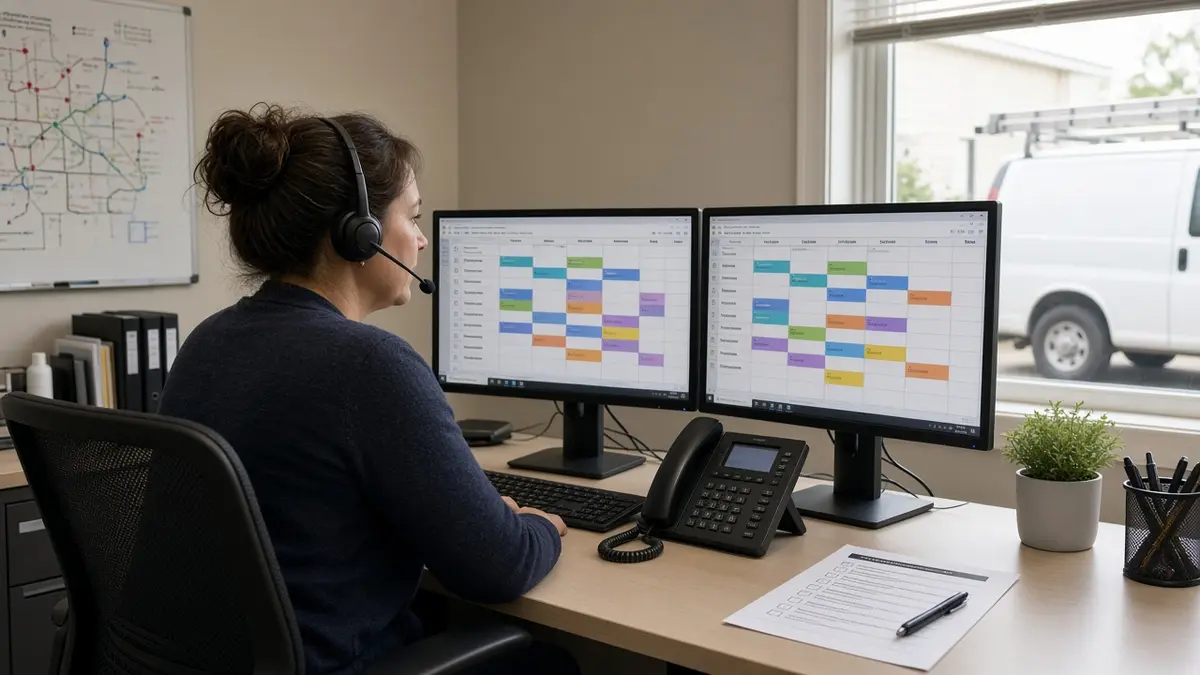
Hire your first dispatcher when the owner or a lead tech is spending 15 or more hours a week on phones and scheduling, or calls are going to voicemail during work hours. Hire for calm triage and scheduling judgment, test with a live board exercise, then onboard over 30 days: shadow, supervised, then owning the board.
Most small shops don't decide to hire a dispatcher. They drift into needing one. The owner answers the phone from a ladder, a lead tech rebuilds tomorrow's schedule at 9 p.m., and the after-hours voicemail fills up. The first dispatcher hire fixes that, but only if the job is defined before the person shows up.
This guide covers when the hire pays for itself, what to pay, how to interview with a real scheduling test, and a day-by-day 30-day onboarding plan with the numbers to check each week. It applies to HVAC, plumbing, electrical, and other residential service shops.
Pay figures below come from the U.S. Bureau of Labor Statistics. All other numbers are illustrative worked examples, not industry benchmarks or customer data. Plug in your own call volume, average ticket, and margins.
When should a contractor hire a first dispatcher?
Watch for the signals, not the headcount. Some shops need a dispatcher at 3 trucks; others run fine at 6 because the work is mostly scheduled maintenance.
| Signal | Example threshold | What it costs you |
|---|---|---|
| Owner time on phones and scheduling | 15+ hours a week | Hours not spent selling, estimating, or managing |
| Calls missed during business hours | More than 1 in 10 | Each missed call can be a lost job to whoever answers first |
| Same-day emergencies per week | 5+ that force a reshuffle | Techs driving back and forth, late arrivals |
| Techs calling the office for the next job | Several times a day per tech | Idle truck time between jobs |
| Schedule built after hours | 3+ nights a week | Burnout and mistakes in tomorrow's board |
If two or more of these are true, the role is already being done. It's just being done by the most expensive person in the building.
How much does a first dispatcher cost, and when does it pay off?
The U.S. Bureau of Labor Statistics reports a national median wage of $23.50 an hour ($48,880 a year) for dispatchers outside police, fire, and ambulance (occupation 43-5032, May 2024 data). The middle half earned between $40,240 and $61,520. Your local market will differ.
Here's a worked break-even example:
| Line | Example value |
|---|---|
| Base wage (BLS median) | $48,880 / year |
| Payroll taxes, benefits, overhead (example 25%) | $12,220 / year |
| Fully loaded cost | $61,100 / year (about $5,092 / month) |
| Average ticket (example) | $350 |
| Gross margin per job (example 50%) | $175 |
| Extra jobs needed to break even | About 29 a month, or 7 a week |
Seven extra jobs a week sounds like a lot until you count where they come from: calls that used to hit voicemail, a tighter board that fits one more call per truck on busy days, and an owner who now has 15 to 20 hours a week back to run estimates. Run your own version with the labor rate calculator and the job profit calculator.
What should a dispatcher job description include?
Keep it to the work they'll actually do in week six, not a wish list. A first dispatcher in a small shop is usually also the customer service rep.
| Section | What to write |
|---|---|
| Core duties | Answer and book calls, build and adjust the daily board, assign the right tech to each job, send arrival and delay updates, rebook cancellations |
| Trade triage | Tell an emergency (no heat in a freeze, active leak, burning smell) from a next-day call, and ask the right intake questions |
| Tools | Your field service software, phone system, and texting; be specific about which ones |
| Hours | Your business hours plus how after-hours or weekend coverage rotates |
| Pay | A posted range; the BLS figures above are a reasonable national starting point |
| Success after 90 days | 2 to 4 measurable outcomes, such as answer rate and on-time arrivals |
Industry experience helps but isn't required. People from logistics, restaurant management, medical scheduling, and busy front desks often learn trade triage quickly because they already handle a full queue calmly.
How do you interview a dispatcher candidate?
Skip the "where do you see yourself in five years" questions. Use a 45-minute work sample that looks like a real Tuesday. Score each part 1 to 5.
| Exercise | Time | What you're scoring |
|---|---|---|
| Phone role-play: an upset homeowner with no cooling | 10 min | Calm tone, gets address, system, symptom, and access details, sets a clear expectation |
| Board triage: 3 new calls into a half-full day (1 emergency, 1 install estimate, 1 routine tune-up) | 15 min | Who goes where and why; whether they protect high-value work and still handle the emergency |
| Delay call: tech running 90 minutes late | 5 min | Calls the customer before the window ends, offers options |
| Software test: enter a customer and book a job in your system | 10 min | Comfort with screens and accuracy of entry |
| Debrief | 5 min | Can they explain their choices out loud? |
A simple scoring rule: weight board triage and phone handling equally, and don't hire anyone who scores below 3 on either. A warm voice with poor routing instincts still costs you drive time.
What does a 30-day dispatcher onboarding plan look like?
Write down what's in the owner's head before day one. The biggest onboarding failure isn't the new hire; it's undocumented rules ("never send the new guy to that customer," "the north side is a 40-minute drive after 3 p.m.").
| Days | Focus | By the end, they can |
|---|---|---|
| Before day 1 | Owner writes the service area map, price ranges they may quote, emergency definitions, and tech skill list | (Owner task) |
| Days 1-2 | Company, services, customers, software logins, phone system | Look up any customer and job history |
| Days 3-5 | Shadow every call; book jobs with the owner watching | Book a routine job without help |
| Week 2 | Take all calls; owner builds the board, dispatcher adjusts it live | Handle reschedules and delay calls alone |
| Week 3 | Dispatcher builds tomorrow's board; owner reviews it each afternoon | Match tech skills to job types correctly |
| Week 4 | Dispatcher owns the board, including emergencies; daily 10-minute review | Run a full day without the owner |
| Day 30 | Scorecard review and 60-day goals | Agree on what "good" looks like next month |
Create a one-page priority matrix together during week one: what counts as an emergency for each trade you serve, what gets same-day service, and what can wait for the next open slot. It ends most "should I bump this job?" interruptions.
Which numbers should a new dispatcher track?
Pick four, review them every Friday, and show the dispatcher their own trend line. Targets below are example starting points; set yours from a two-week baseline.
| Metric | How to measure | Example 30-day target |
|---|---|---|
| Call answer rate | Answered calls ÷ total calls during business hours | 90% or higher |
| Booking rate | Booked jobs ÷ calls from people needing service | Improve on your baseline |
| On-time arrival | Arrivals inside the promised window ÷ total arrivals | 85% or higher |
| Jobs per truck per day | Completed jobs ÷ truck-days worked | Hold steady or rise as the board tightens |
Add callbacks once they're comfortable. A dispatcher who links every return visit to the original job makes your callback rate measurable.
What mistakes do owners make with their first dispatcher?
- Hovering on the board. If the owner keeps dragging jobs around after week four, the dispatcher stops owning the outcome.
- No authority to say no. Give them clear rules for when they can push a job, decline a quote request, or call in a second tech.
- Hiding the numbers. Dispatchers improve faster when they see answer rate and on-time arrivals every week.
- Using a whiteboard and group texts. Your dispatcher can't see where techs are, what they've finished, or what parts they have, so they end up calling techs all day.
- No backup. Cross-train one other person to cover lunches, vacations, and sick days.
How does dispatch software help a first-time dispatcher?
The right tool shortens the learning curve because the history, notes, and status are on the screen instead of in someone's memory. JobOpsPro gives dispatchers a drag-and-drop dispatch board, customer and equipment history on every job, and job status that updates from the tech's phone as they go en route, arrive, and finish. Scheduling ties into HVAC scheduling and the estimate-to-invoice workflow, so the dispatcher isn't re-entering anything, and the books sync to QuickBooks Online.
It's $25 per user per month with every module included, with no annual contract and no implementation fee. See pricing, walk through dispatching a job, or read how the dispatch board works as the owner's command center. Shops comparing options can start with our HVAC dispatch software guide or see how it fits HVAC and plumbing companies.